At the start of last week, I spent three days in Taipei at the invitation of the Institute for Information Industry (III), attending the AI Manufacturing Asia-Pacific Collaboration programme representing IoT Forum New Zealand. It ran alongside the 2026 Taitronics & AIoT Taiwan expo and was advised by the Industrial Development Administration of Taiwan's Ministry of Economic Affairs.[3] The programme had three parts: a roundtable of industry associations from across the region, a guided tour of the expo, and an AI Smart Manufacturing Showcase with Taiwanese solution providers.
I went to listen as much as to contribute. New Zealand is a small market and a long way from most of the conversations that shape how AI reaches the factory floor. Rooms like this one are how a country our size stays connected to what the rest of the region is actually doing, as opposed to what the headlines say it is doing. This piece is my account of what I saw, what I took in with me, and what I think comes next.
The most useful thing I saw in Taipei wasn't a product. It was a pattern: AI adoption in the physical world (the focus here was on manufacturing) is treated as something measurable, shared, and led through industry associations.
1. A Room Built Around Associations, Not Vendors
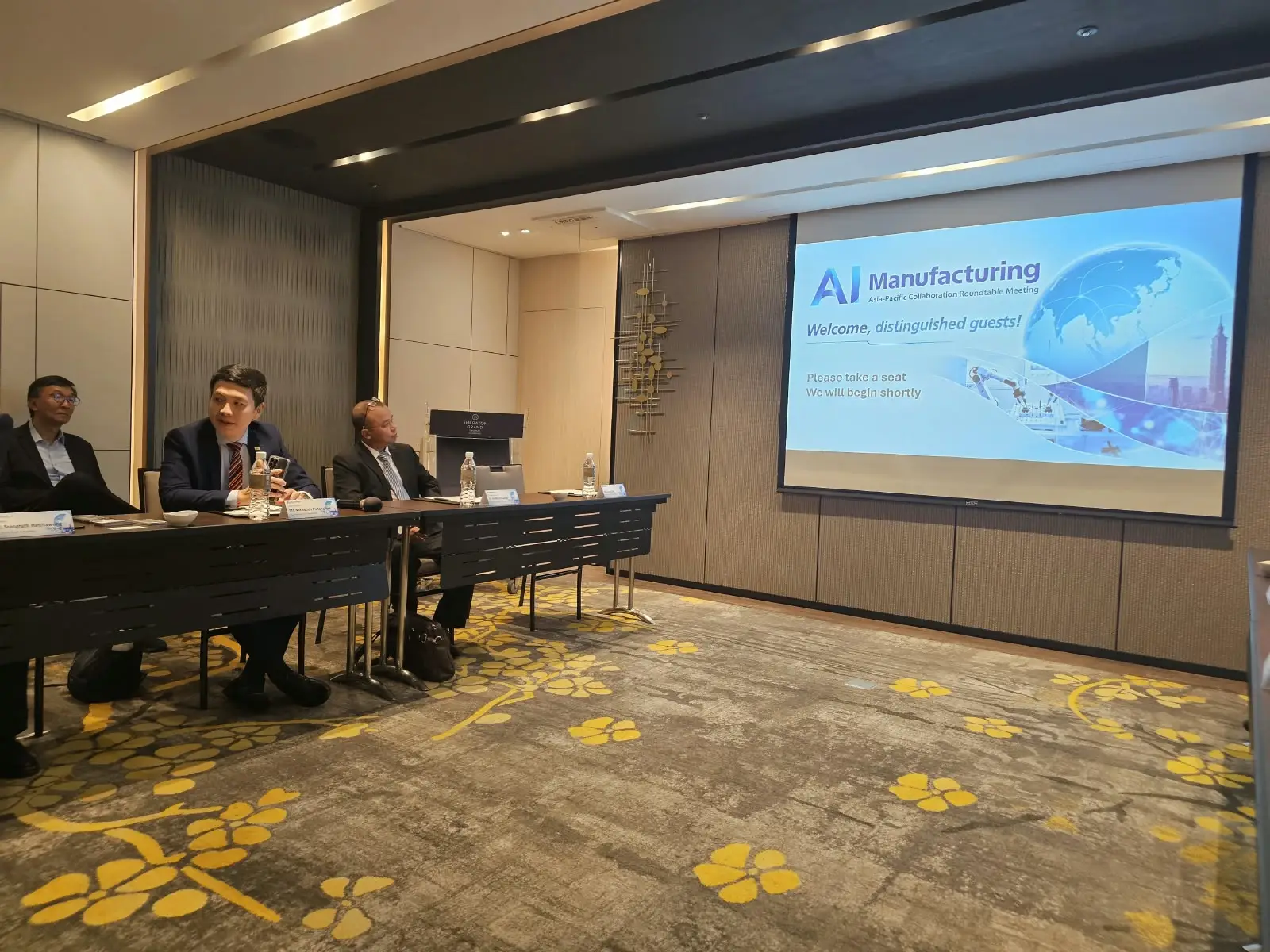
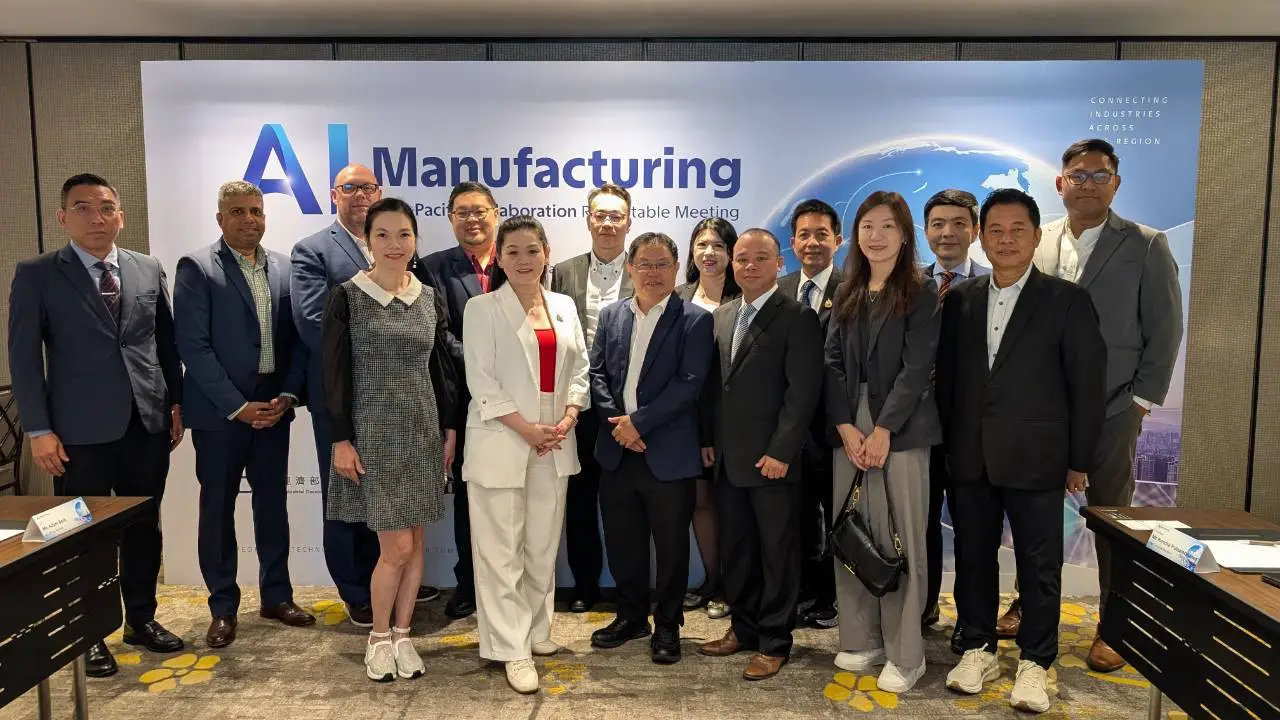
The roundtable's design told me a lot before anyone spoke. The participant list named industry associations and alliances from seven economies: Australia, Malaysia, New Zealand, Singapore, Taiwan, Thailand and Vietnam, with Thailand alone represented by five organisations spanning IoT, edge computing, digital entrepreneurs, and trade.[3] It was also great to attend alongside my colleague Adam Beck from the Connected Technology Alliance in Australia, where I also serve on the board.
The format was just as deliberate. No formal presentations were required. It was a moderated discussion, built around three questions: where is AI adoption in manufacturing right now in your market, what can we learn from each other about moving from exploration to implementation, and what could we actually do together across borders.[3] The organisers were also open about the ambition behind it: a starting point for sustained regional collaboration that could grow into a regular platform, potentially with annual meetings and joint activities.[3]
That choice matters. Associations hold something vendors can't: the trust of a membership that has to live with the results. A country-by-country conversation between associations is slower than a procurement meeting, but it is much closer to how adoption really spreads.
2. Measuring Before Scoping
The roundtable keynote from III centred on manufacturing industry AI maturity, and the piece of work at its core is a diagnosis tool III has built. It is open source, designed by III and evaluated by 800 Taiwanese manufacturers, and III says it has helped more than 1,000 companies introduce AI tools to solve operational problems.[3] A company answers 19 standardised items across five core dimensions plus its operational pain points, receives an automated radar chart and maturity level, and is matched to tools from an AI toolbox in a PDF report.[3]
I like this for a practical reason. Most AI projects I see stall because nobody agreed on the starting point. A company says it wants AI, a vendor offers a platform, and six months later there is a pilot nobody can place on a map. A shared diagnostic gives a manufacturer, an association and a solution provider the same picture to argue over.
When I read a maturity assessment, I read it through Sense, Reason and Act. Where does the business actually capture data from its machines and processes? Where are decisions made from that data, and by whom? And where, if anywhere, does a decision close the loop and change something physical without a person re-keying it? A company can score well on analytics and still have nothing at the Act end. That gap is where Physical AI begins, and I'd want any maturity tool, including this one, to make it visible.
The question I took away is how well a general maturity score captures physical-world readiness: sensing coverage, edge processing, and the state of the links between operational technology and IT. That is where the pilots I see in New Zealand tend to break. It would be worth finding out how the tool treats it.
3. The View from New Zealand, and from the Table
The points I prepared for the roundtable came straight from what IoT Forum NZ members tell me. New Zealand manufacturers are moving from AI pilots toward AI at the edge, with vision-based quality inspection and predictive maintenance leading in food, beverage and agritech. Adoption is real but uneven. Pilots are common, scaled deployment is rare, and larger exporters are furthest ahead.
The barriers are not a shortage of ideas. They are integration capacity, data readiness and hybrid skills. Legacy OT and IT silos stop pilots reaching production, messy data and brittle links to old systems usually fail before the model does, and the scarcest people are the ones who understand both operations and AI. The drivers are familiar: labour shortages, cost pressure, sustainability reporting and export competitiveness.
What I heard around the table was reassuring and a little humbling. Much of it was our own story told from different regional perspectives.
The SME problem is everywhere. Vietnam's delegate described an economy of around 500,000 enterprises, 93% of them SMEs, where most of the AI use today sits in content creation and the digital economy, and where AI in manufacturing remains a hard problem. Taiwan's AI association and Malaysia's delegate both put SMEs at the centre of their focus. Thailand's edge computing voice asked who is actually driving AI in manufacturing, and named the data challenge facing SMEs. That is the question I'd put to any New Zealand manufacturer, because the answer is often nobody in particular.
Data came up again and again. The Thai IoT Association argued that manufacturers should start with IoT before AI, and that data standards matter, along with the risk of AI hallucination on the factory floor. A delegate from Thailand's trade community put it more bluntly: no data, no AI. I could have written both lines myself. They are the Sense pillar, said by people who have watched projects fail without it. Vietnam's version was the one I wrote down twice: measure first, automate later.
Start with IoT before AI. No data, no AI. Measure first, automate later. Three delegates from three countries made the same point in different words.
Two contributions pushed my thinking in directions I didn't expect. Singapore's AutomationSG described AI as a strong engine that also needs strong brakes, and framed trusted AI readiness around business continuity, compliance and governance. That is the right order of concerns for regulated and export-facing manufacturers, and it lines up with the governance questions I keep raising with boards. Thailand's edge computing group also asked how to optimise edge compute costs, including whether a local language model could serve edge AI at lower cost. I hear that question more each month, and I don't think the industry has a settled answer yet.
The conversation also stretched beyond the factory gate. Thai delegates pointed to electronics logistics and supply chain, and to smart city, public safety and healthcare use cases, with sports events as a showcase for AI in crowded public spaces. That sits close to the Urban Physical AI argument I made in the room, and it told me the appetite for AIoT outside manufacturing is already there.
4. Edge Intelligence Now
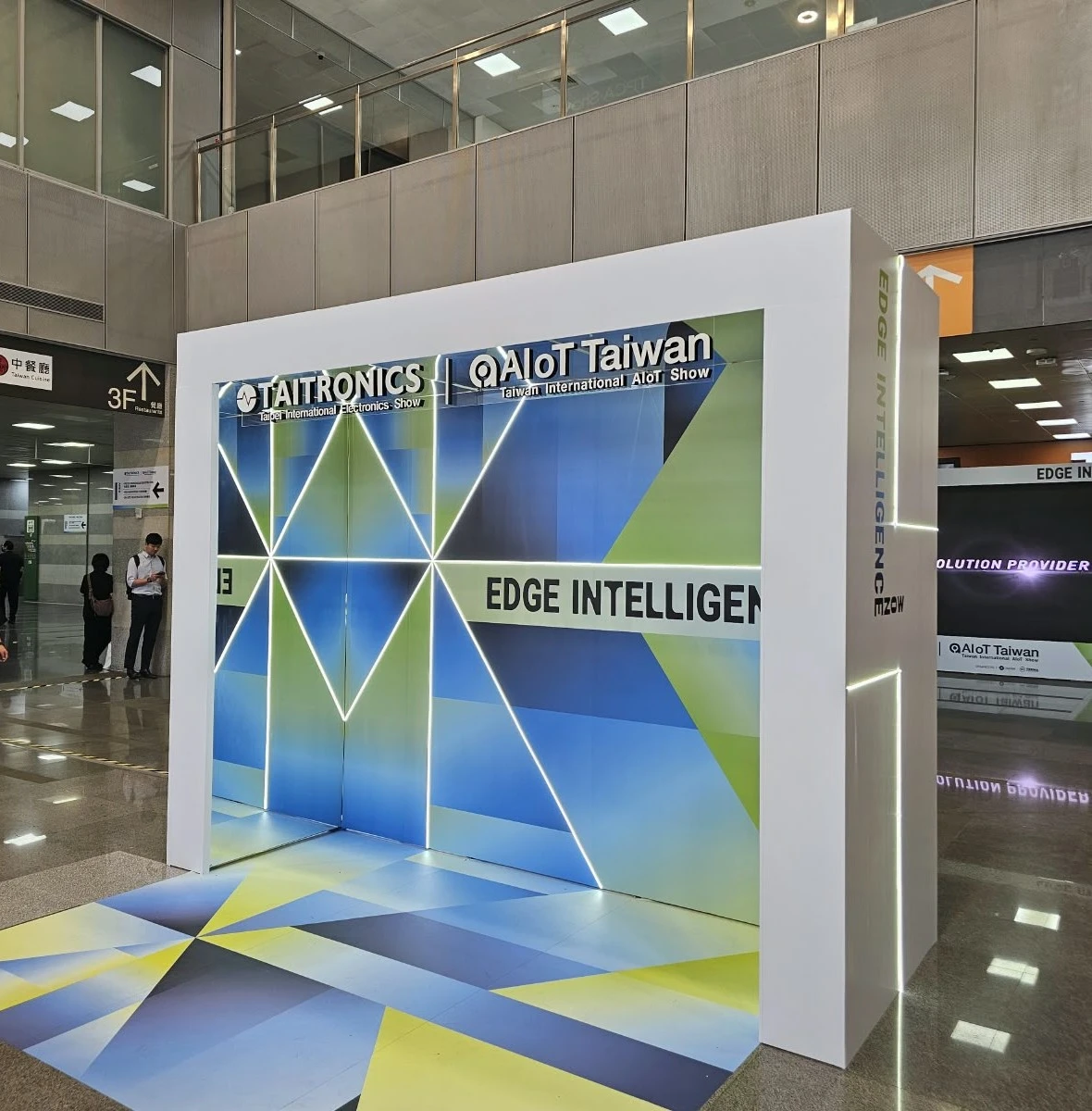
The expo itself was a useful read on where the industry's attention sits. This year's Taitronics & AIoT Taiwan ran under the theme "Edge Intelligence Now", with 260 exhibitors across 480 booths organised around five themes: AI applications, next-generation communications, embedded systems, smart power and sustainable innovation.[1] The Ministry of Economic Affairs pavilion showed 65 innovations, and the opening remarks put the emphasis where I'd put it: the value of AI is in applying it to factories, products and daily operations to solve real problems.[2] The "Big Bang Startup Zone" brought in startups from 11 countries showing AI agents, edge AI and smart manufacturing.[1]
Anyone who read my last article, Still Listening, will see why that theme caught my attention. The argument there was that sensing has stopped being a training input and become an operating input, and that where processing happens, on the device, at the edge or in the cloud, is a decision about how honest a system can be about the present moment. A major Asian trade show choosing "edge intelligence" as its organising idea is the market saying the same thing in hardware.
What I found most telling was the shape of the supply chain on show. The organisers described the strength as integration, from chips to systems and from factories to campuses.[1] That is the Sense, Reason and Act stack seen from the component side, and it is a reminder that Taiwan's advantage is not any single technology. It is how closely the pieces sit together.
Walking the halls, what struck me was that this wasn't an electronics show with an AI corner. The whole expo was organised around AIoT, and Physical AI was close to the centre of the conversation at nearly every stop. Chips, sensors, connectivity, power and applications were presented as one connected stack, and exhibitors from Taiwan and well beyond were showing intelligence moving out of the cloud and onto the device, the machine and the site. That is the regional momentum I've been describing in this series, and it was a different experience to see it at that scale in one place.
5. From Conversation to Introductions
The second day moved from policy to practice. The AI Smart Manufacturing Showcase put the visiting delegations in a room with Taiwanese AI and smart manufacturing solution providers. We heard from TPI Software, Intumit, Aira, Harbor Technology Solutions, FS-TECH, Portwell, Morale AI and ZiG.[3]
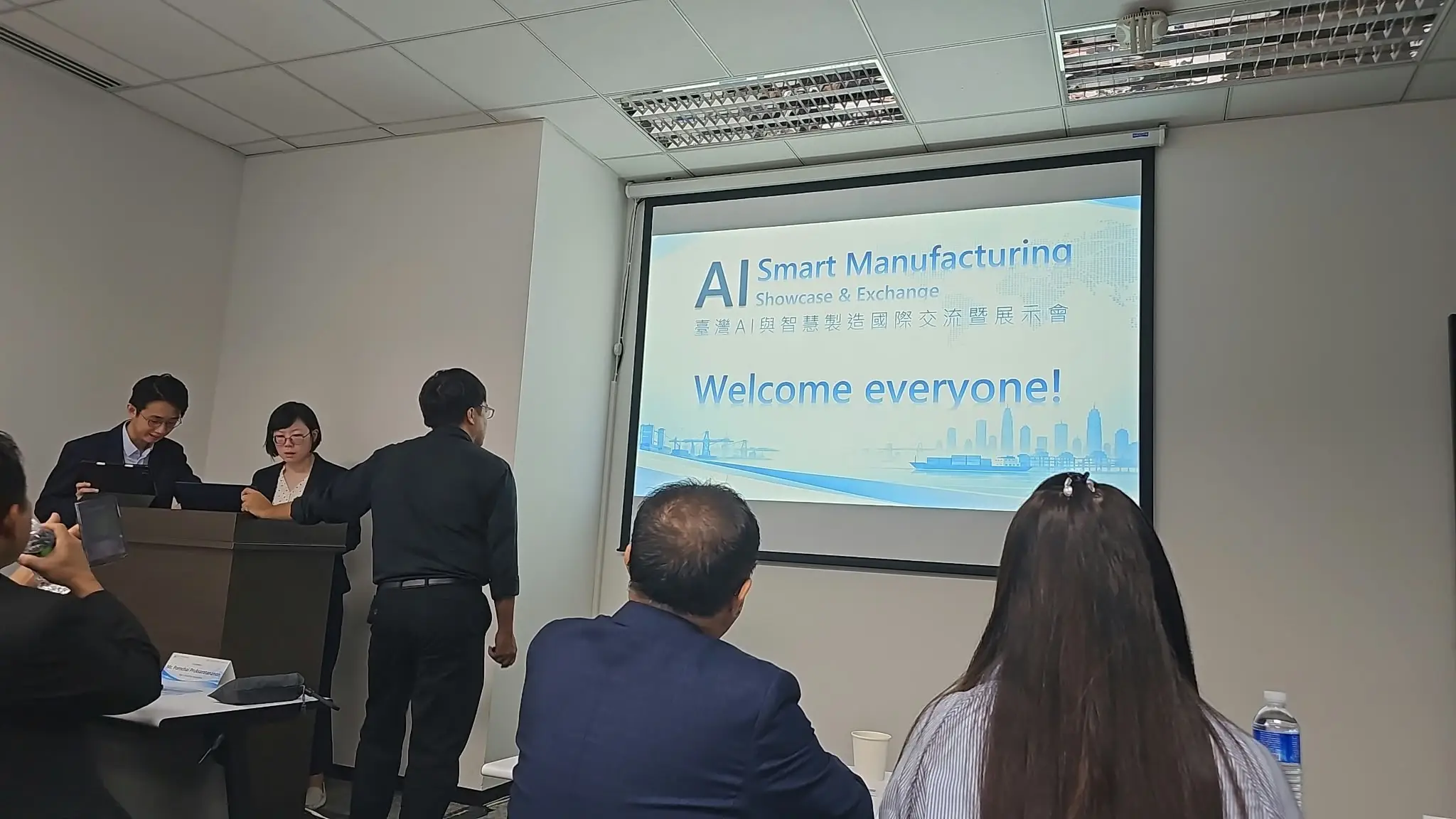
The sequencing is worth copying. A roundtable establishes a shared view of the problem, a showcase puts real providers in front of the people who might use them, and the expo gives everyone a wider frame of reference. Each step makes the next one more productive.
6. What I Put on the Table
The organisers asked each association for one concrete opportunity it would be willing to explore. Mine was a regional AIoT resilience working group.
The reasoning is simple. Natural disasters and ageing assets are shared risks across our region, and New Zealand has recent, hard-won lessons. Cyclone Gabrielle showed what happens when critical services lose situational awareness at the worst moment. AIoT can move infrastructure beyond sensing and monitoring to earlier failure detection, better awareness during disruption and faster recovery of water, energy and transport services. These are problems where no single country's data is enough and where lessons travel well.
A regional AIoT resilience working group, backed by a shared library of pilot case studies and reference architectures, is a practical first step. It is small enough to start and useful from day one.
I also pointed to Urban Physical AI as a second area worth shared effort. Smart cities have to move from sensors that collect information to systems that collect data, reason with it and generate meaningful actions for citizens and public sector operations. That is the Sense, Reason and Act argument applied to a city.
On activities, the ones I see most value in are business matchmaking, technology exchange and joint pilots, with factory and city-operations visits and talent exchange as practical extras. IoT Forum NZ is ready to contribute through regular exchanges, joint activities and a light annual roundtable.
7. What Would Make This Real
Regional platforms have a poor record of surviving their first meeting. The enthusiasm in the room is real, and then everyone returns to their day job. Three things would improve the odds.
First, an owner. Someone has to hold the shared library and the calendar, or neither will exist in six months. Second, a small scope. One or two joint pilots with named participants are worth more than a long list of areas of interest. Third, a common language for what a good pilot looks like, which is where a shared maturity framework and shared reference architectures earn their place.
There is already momentum to build on. Singapore raised the idea of an ASEAN working group on AI, and delegates from Vietnam and Malaysia each called for a stronger Asia-Pacific community and more collaboration across borders. A working group on AIoT resilience would sit comfortably alongside that, and would give Australia and New Zealand a clear way in.
I am glad III is willing to convene and I intend to hold up New Zealand's end. If you are a New Zealand manufacturer, integrator or infrastructure operator working on AIoT and Physical AI and want to be part of what comes out of this, get in touch with me through IoT Forum NZ or Synaptec.
Closing Thought
Every country in that room is working through the same problem from a different starting point: moving from AI that reports to AI that acts, on equipment and infrastructure that was not built for it. None of us has solved it, and none of us will solve it alone. The value of a roundtable like this one is that it shortens the time it takes to learn what the others already know.
The region's AI manufacturing challenge is shared, and so is the fastest way through it: common measures, shared pilots, and associations willing to do the connecting.
Sincere thanks to the Taiwan Institute for Information Industry and the Taiwan Industrial Development Administration for the invitation and the hospitality, and to the delegates who made the discussion worth travelling for.
References
- Commercial Times (工商時報). (2026, October 20). 2026 TAITRONICS and AIoT Taiwan opening report (in Chinese). https://www.ctee.com.tw/news/20261020701670-431202
- TechNews. (2026, October 20). TAITRONICS and AIoT Taiwan opening coverage (in Chinese). https://finance.technews.tw/2026/10/20/taitronics-ai/
- Institute for Information Industry (III) and Digital Transformation Research Institute. (2026). AI Manufacturing Asia-Pacific Collaboration: Programme Overview and Roundtable Meeting Participant Discussion Guide. Programme materials supplied to participants. https://www.iii.org.tw